
Arcjet Himalia 1: What the New Prompt Injection Model Does and How to Test It
Also available in Hindi: यह लेख हिंदी में पढ़ें
On 5 November 2026 Arcjet announced that its prompt injection detection now runs on Arcjet Himalia 1, a custom model it fine-tuned from Qwen3-0.6B. It is live for every SDK call that uses prompt injection detection, so existing users do not need to change code. Arcjet also announced two specialist models, Thebe 1 for coding agents and Carme 1 for autonomous security agents, but those are early access only. This guide covers what the announcement says, what the scores do and do not prove, and how to test the model without blocking real users. It is based on Arcjet's launch post and docs, checked on 5 November 2026.
What changed
Arcjet says the previous detection combined two open-source classifiers and produced regular reports of false positives and false negatives. Himalia 1 replaces them. Arcjet gives three reasons for training its own model: very few prompt injection models allow commercial use, public datasets overlap heavily and sometimes label the same prompt both ways, and datasets disagree about what counts as an attack.
How Himalia 1 is built
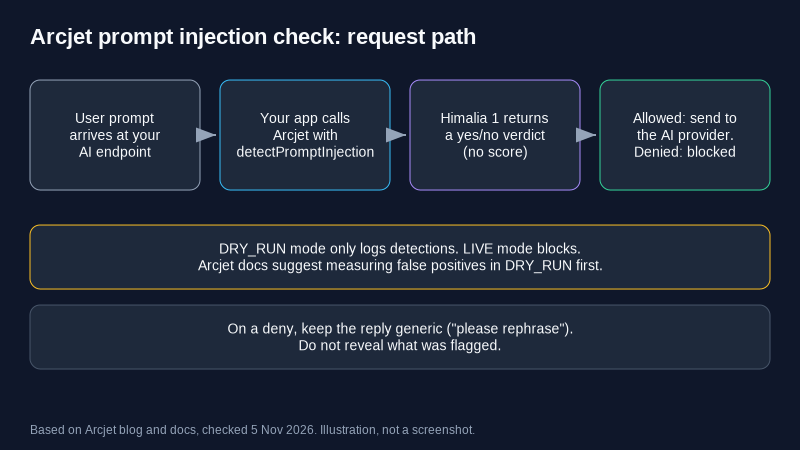
Arcjet describes a full fine-tune, not a LoRA adapter, of Qwen3-0.6B, a 0.6-billion-parameter model under the Apache 2.0 license. The text-generation output is replaced with a two-way classification head (benign or injection). That makes it roughly a thousandth the size of a frontier model. Arcjet's case for a classifier is that it reads the text once, outputs a label, and returns the same answer for the same input.
Two production details are worth knowing. Arcjet runs deterministic decoders for encoded text such as base64, ROT13 and hex, and sends the decoded text to the model alongside the original. And the result is a verdict, not a score. Arcjet says a score would give attackers feedback to tune a payload, and would shift whenever the model is retrained.
Vendor-reported results
Arcjet published results on two public datasets:
| Dataset | F1 | Precision | Recall | False positive rate | False negative rate |
|---|---|---|---|---|---|
| neuralchemy/Prompt-injection-dataset | 0.964 | 0.969 | 0.958 | 0.044 | 0.042 |
| jackhhao/jailbreak-classification | 0.971 | 0.978 | 0.964 | 0.024 | 0.036 |
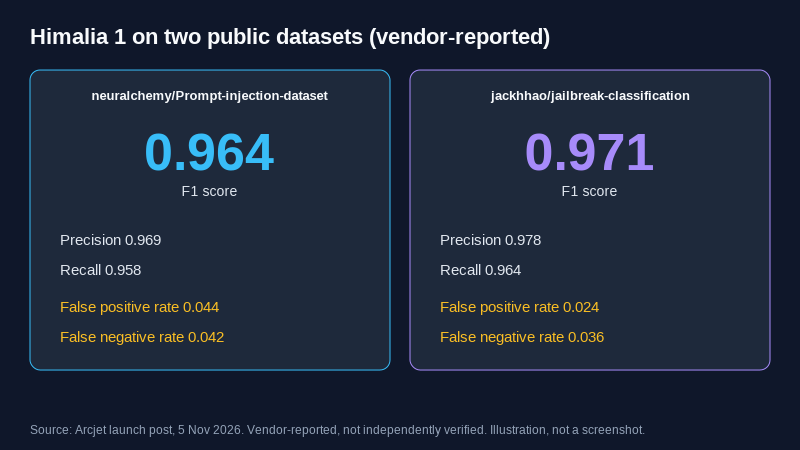
Treat these as the vendor's numbers. Arcjet says it removed training rows that also appear in its evaluation sets, and that it tested on proprietary data too, but those results are not published. It also warns that public datasets overlap heavily, so published scores can overstate accuracy on new input. A 4.4% false positive rate would still flag roughly one in twenty-three benign prompts, so test on your own traffic.
How to test it safely
- Use DRY_RUN first. Arcjet's docs say
mode: "DRY_RUN"logs detections without blocking, so you can measure false positives before switching to"LIVE". - Configure it in code. The docs say prompt injection detection needs the request body, so it is SDK-only and cannot be a remote rule.
- Read the verdict. In JavaScript use
decision.reason.isPromptInjection(). There is no confidence score to threshold. - Keep denials generic. The docs recommend a plain "rephrase your message" instead of explaining what was flagged.
- Plan for latency. The docs, which pre-date the Himalia launch, say detection adds about 100 ms per request. Measure it in your own app.
It is one layer, not a full defence. Pair it with our vibe coding security checklist, and remember that agents also meet injected content in tool results and fetched pages (background in our MCP explainer).
Himalia, Thebe and Carme
- Himalia 1: general chatbots and model endpoints. Conservative, so SQL, shell commands or "print your instructions" count as suspicious.
- Thebe 1: coding agents, where SQL and shell commands are normal and the risk is what the agent pulls in, such as tool output or fetched pages. Early access.
- Carme 1: autonomous security agents that read CVEs and advisories, which are full of attack words by design. Early access.
Our take
This is a vendor announcement with vendor-reported scores, and I found no independent testing yet. The design is sensible, though: a small, fast classifier in the request path, a verdict instead of a score, and a dry-run mode. If you already use Arcjet, log in DRY_RUN for a week, compare flagged prompts with real traffic, and only then enforce.
Sources
- Arcjet blog: Introducing Arcjet's custom AI security models (5 Nov 2026)
- Arcjet docs: Prompt injection detection
- Arcjet docs: AI protection, prompt injection
- daily.dev summary of the Arcjet post
FAQ
What is Arcjet Himalia 1?
It is Arcjet's general-purpose prompt injection detection model, a full fine-tune of Qwen3-0.6B with a two-way classification head. Arcjet says it is live for every SDK call that uses prompt injection detection.
Do I need to change my code to get Himalia 1?
Arcjet says it is live for every SDK call that uses prompt injection detection, which indicates existing integrations get it automatically. Check your own logs after the change.
Can I get Thebe 1 or Carme 1 today?
Not self-serve. Arcjet describes both as early access and asks coding-agent and security-agent teams to contact it.
Are the 0.964 and 0.971 F1 scores independently verified?
No. They are vendor-reported on two public datasets. Test the model on your own prompts in DRY_RUN mode before blocking.