
Together Compiler: How AI Agents Keep Inference Fast, and What the Numbers Mean
Also available in Hindi: यह लेख हिंदी में पढ़ें
On 4 November 2026 Together AI introduced Together Compiler, a system in which AI agents keep rewriting and re-testing the code that serves open models, so inference stays tuned as traffic changes. Together says it reaches up to 2.6x higher tokens per second (TPS) than the best published configurations in under 24 hours per setting, and that it already runs on selected production endpoints. Those are Together's own figures, and I found no independent test yet. This guide explains the idea, labels the numbers, and lists what API users should conclude. It draws on Together's two launch posts and a MarkTechPost report, read on 5 November 2026.
The problem it targets
Together argues that inference is no longer one static recipe. Models differ (it says none of the top-10 open-source LLMs on OpenRouter share an architecture), hardware differs (H100, B200, B300 and more), and each customer sends a different traffic shape. Together reports one country's working-hours prompts ran 1.4x longer than another's (97k against 70k tokens). A configuration tuned once goes stale, and hand-tuning every case does not scale. Together calls its answer "Polymorphic Inference", with Together Compiler as the first step.
How it works
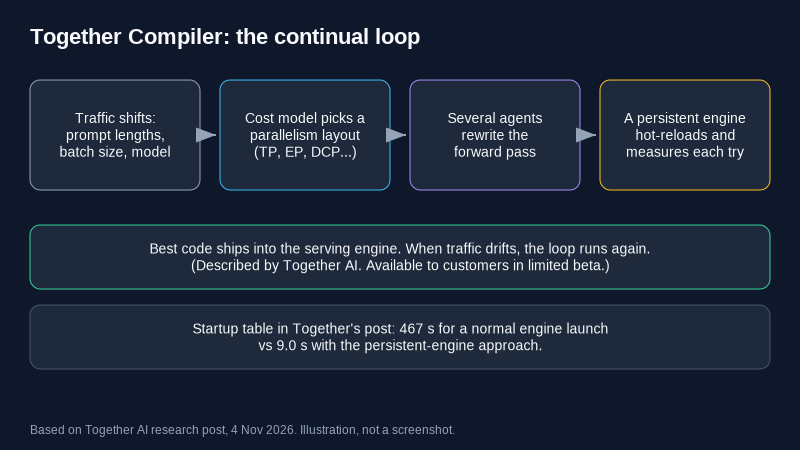
Together Compiler takes a traffic shape, a model and a hardware setup, then uses several agents to propose faster versions of the model's forward pass. Together describes three ideas.
- Persistent engines. Agent systems usually restart an engine such as vLLM, SGLang or TensorRT-LLM for every experiment. Together's table lists 467 seconds to start serving against 9.0 seconds with its approach, where one engine starts once and hot-reloads each candidate. MarkTechPost cites a separate 761-second figure for one MiniMax setup, so startup costs vary by model and engine.
- Two measurement tiers. Fast engines load a few layers for quick tests, and slower engines load many layers to check gains on realistic data.
- A cost model. It picks parallelism layouts (TP, EP, DCP) using hardware specs, microbenchmarks and measured forward passes, instead of specs alone.
The numbers, with labels
Everything below is vendor-reported. Together says that in under 24 hours Together Compiler reached up to 2.6x higher TPS on Kimi K3, GLM 5.3, MiniMax M3.1-Flash and DeepSeek v4.1-Flash, 1.7x over open-source megakernels on Llama 1B at batch size 1, and 252x the experiment throughput of baseline agent systems. MarkTechPost lists the batch-size-1 results, labelled self-reported:
| Model (hardware) | Together Compiler TPS | InferenceX best TPS |
|---|---|---|
| MiniMax M3.1 Flash (B200) | 1,111 | 633 |
| DeepSeek v4.1 Flash (GB300) | 1,205 | 943 |
| GLM 5.3 (B200) | 417 | 329 |
| Kimi K3 (GB300) | 450 | 423 |
| GLM 5.3 (MI355X) | 480 | 463 |
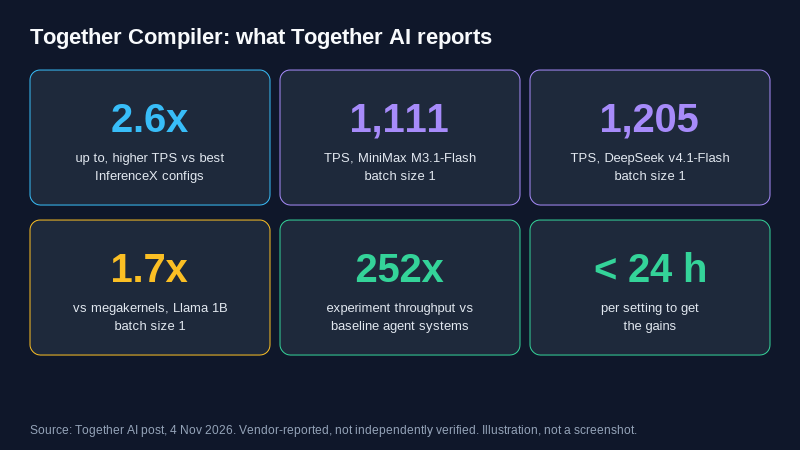
The spread matters. The 2.6x figure is the best case. The table shows gains from about 4% (GLM 5.3 on MI355X) to about 75%, and these are per-user speeds at batch size 1, not a statement about cost per token or about every workload.
Availability
Together's second post says Together Compiler is running in production on some of its most popular serverless endpoints, and that it is available to end customers in limited beta. Together says customers will soon be able to optimise dedicated endpoints "at the click of a button". "Soon" is not a date, so do not plan around it yet.
What API users should do
- Do nothing now. There is no new switch for serverless users. If Together's claim holds, you may see faster responses on some models without changing code.
- Measure your own latency. Record time to first token and tokens per second for your prompts before and after any change. Our AI API pricing guide explains why price per token is only part of the cost.
- Ask for the beta if you run dedicated endpoints. Together says early access is by request.
- Keep expectations modest. Together notes its batch-size-1 results used its own cost model's layout, not InferenceX's.
If you are comparing hosting options for agents, see our AI agent hosting options guide.
Our take
Continual re-tuning is a sensible idea, and Together publishes enough detail, including per-model baselines through MarkTechPost, to be checked later. But all the results are self-reported, and Together's own page metadata mentions "up to 3.7x" while the article text says 2.6x, so quote 2.6x only as "Together says". Wait for independent benchmarks before changing providers.
Sources
- Together AI: Together Compiler, Continual Compilation for AI inference (4 Nov 2026)
- Together AI: From Static to Polymorphic Inference (4 Nov 2026)
- MarkTechPost: Together AI Releases Together Compiler (5 Nov 2026)
FAQ
What is Together Compiler?
It is Together AI's agent-driven system that rewrites and re-tests a model's forward pass as traffic, models and hardware change, using persistent engines that hot-reload each candidate.
How much faster does Together say it is?
Up to 2.6x higher TPS than the best published InferenceX configurations in under 24 hours per setting. This is vendor-reported, and some settings gained only about 4%, according to MarkTechPost.
Can I use Together Compiler myself?
Together says it is in limited beta for end customers and already runs on some serverless endpoints. Self-serve dedicated-endpoint optimisation is described as coming soon, with no date.
Should I switch providers because of this?
Not on this evidence. The figures are self-reported, so compare latency and cost on your own workload first.