IOTA Decide 4B: An Open-Weight Decision Model for Ticket Triage
Also available in Hindi: यह लेख हिंदी में पढ़ें
On 4 November 2026 Macrocosmos published IOTA Decide 4B v0.4, an open-weights model that does not write text at all: you give it a situation and a few typed questions, and it returns calibrated probabilities. It is Apache-2.0 licensed, and the weights are on Hugging Face. If you build support tools, approval flows or routers, this is a small model you can run yourself for yes/no, multiple-choice and rating decisions. This guide explains how it works, shows a ticket-triage example, and flags what the vendor's scores do and do not prove.
What kind of model is this?
IOTA Decide is a "decision model". Instead of generating a paragraph, it takes a state (for example a ticket) plus one or more typed questions and answers each with one forward pass. The model card says questions in the same request are answered independently. It is built on Qwen3.5-4B with LoRA fine-tuning merged in, and Macrocosmos says it was trained over the internet across 16 consumer RTX A4000 GPUs using streaming DiLoCo. The weights are 8.41 GB in bf16, text only.
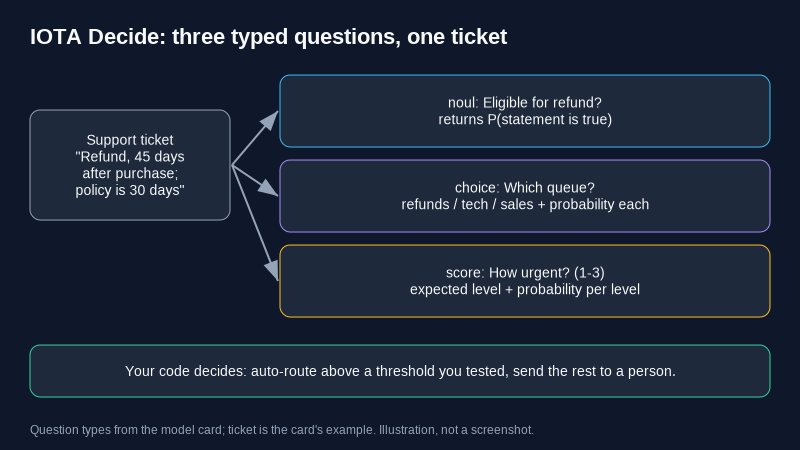
There are three question types:
- noul returns the probability that a statement is true.
- choice returns the pick, a confidence and a probability for each option (2 to 26 options).
- score returns an expected level, a confidence and a probability per level.
A ticket-triage example
The model card's own quickstart is a refund ticket: a customer asks for money back 45 days after buying, while the policy allows 30. You would ask three things at once. Is the customer eligible (noul)? Which queue should handle it (choice: refunds, tech or sales)? How urgent is it (score, 1 to 3)? You get numbers back for each, so your own code can decide: auto-route above a threshold, send everything else to a person.
Set thresholds with care. The model card says yes/no answers are reported with at least 0.801 on the chosen side, because the benchmark treats 0.2 to 0.8 as abstaining. A fixed "90% sure" cut-off therefore needs testing on your own tickets.
Running it locally
Install the dependencies listed on the card: pip install torch "transformers>=5" accelerate safetensors huggingface_hub. Then use the bundled letter_decide.py loader (load_release_model and systemone). Do not use the usual model.generate. Version 0.4 uses two-way attention in its full-attention layers, so vLLM, SGLang, llama.cpp and plain generate give lower scores, and there is no GGUF file. That matters if you hoped to run it through Ollama or LM Studio. Since the weights alone are 8.41 GB, plan for a GPU with comfortably more memory than that. Macrocosmos lists its IOTA SDK as "coming soon".
Vendor-reported scores
On JevBench (Benchmark Heaven v1.8.1), v0.4 scores a composite of 78.6, behind Torchcast Decision 4B v1.3 at 80.5 and ahead of OpenAI Decisions at 62.4. The composite averages intelligence, calibration, speed and cost equally. v0.4 scored 60.2 on intelligence, 87.8 on calibration, 92.2 on speed and 83.0 on cost, with about 33 ms per decision on one GPU.

Treat these as vendor-reported. The Benchmark Heaven board listing for v0.4 is still pending. Macrocosmos's own cross-domain test (15 benchmarks) gives v0.4 63.0 against 65.6 for Torchcast, and it admits 387 of 9,012 questions (4.3%) share text with training data. It also chose the checkpoint using the public JevBench split, so that split is not an independent test.
Where it is weak
The card lists multi-step arithmetic, causal and multi-step narrative reasoning, and humour as weak spots. It is text only, and only English was evaluated. Keep a human in the loop for high-stakes medical, legal, credit or hiring decisions, and check the licences of the third-party training datasets.
How it compares
OpenAI's Decisions API is a hosted service rather than weights you run. Sarvam Prism is another open decision model, but it needs a much bigger GPU. IOTA Decide's pitch is a small, self-hosted option. One caution for Langfuse users: the Langfuse AI Gateway does not serve decision models yet, so these calls cannot go through it.
Sources
- macrocosm-os/iota-decide-4b-v0.4 model card (Hugging Face)
- tao.media: Macrocosmos releases IOTA Decide 4B, fine-tuned across 16 distributed GPUs (4 Nov 2026)
- Langfuse: known limitations of the AI Gateway beta
FAQ
Is IOTA Decide 4B free for commercial use?
The model is released under Apache-2.0. The model card says the third-party datasets used in training keep their own licences, so review those before shipping a product.
Can I run it with Ollama or llama.cpp?
Not with good results. The card says v0.4 needs its own loader because of two-way attention, and stock generate, vLLM, SGLang and llama.cpp give lower scores. There is no GGUF.
Is it better than OpenAI Decisions?
On Macrocosmos's reported JevBench composite it scores 78.6 against 62.4 for OpenAI Decisions. Those are vendor-reported numbers, so test both on your own data.
Does it write explanations for its answers?
No. It returns probabilities, not text. If you need a written reason, pair it with a normal language model.